📅 May 26, 2026
🎹 Polyphonic Synthesizer
💻 Platform: Windows
🔄 v1.0.7 — Latest
🎵 VST3 · AAX
174 Mod Routes
🆓 30-Day Free Demo
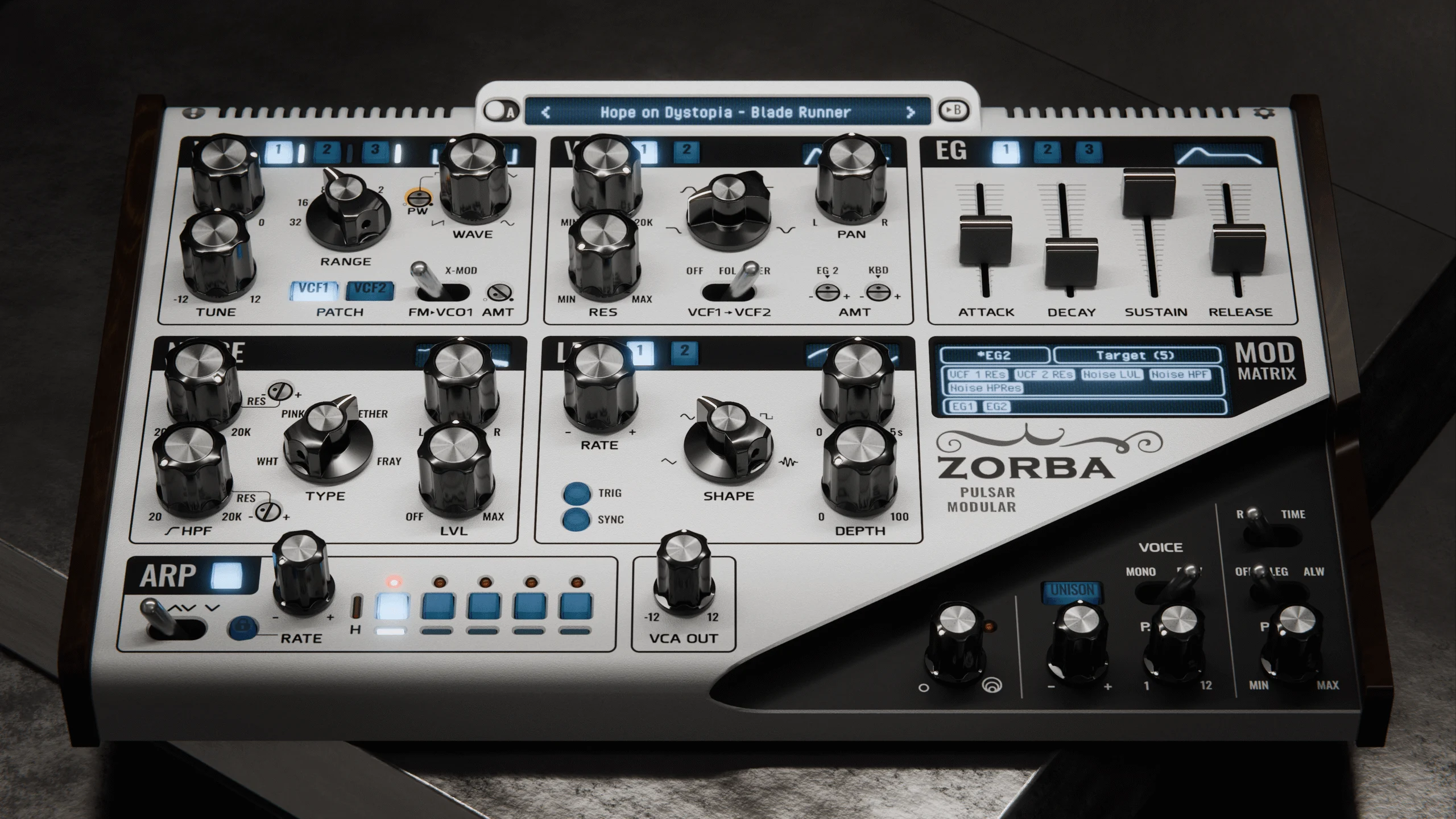
Pulsar Modular ZORBA is a mono and polyphonic soft synthesizer for Windows — built on forty years of analog DNA from the Pulsar Modular P900 heritage. ZORBA means “The Tyrant” — a ruler with unlimited power — and it lives up to its name as a crushing, versatile synthesizer that can be a Juno on your first patch, a Jupiter on your second, and something neither could imagine on your third. At its core sits a signal architecture of 3 VCOs, 2 independent 904-F State Variable Filters, 3 Envelopes, 2 LFOs, an independent noise path, a 5-step accent arpeggiator, and a built-in plate reverb — all tied together by a 174-route modulation matrix spanning 10 sources and 38 unique targets. ZORBA launched on May 26, 2026 at version v1.0.7 and includes a 30-day fully functional free demo. Available in VST3 and AAX for Windows 10+.
💡 Quick Summary
Pulsar Modular ZORBA Windows v1.0.7 (May 26, 2026) — Mono/Poly/Unison synthesizer. Architecture: 3 VCO (continuous waveform morph) + 2 VCF (904-F SVF, 4 modes each) + 3 EG + 2 LFO + independent noise path (4 types, own HPF/LPF) + 5-step accent arpeggiator + built-in plate reverb (0.47–9.31s). 174 mod routes · 10 sources · 38 unique targets. Zero sample delay — no PDC. CPU-light, stackable. Windows 10+ · x64. VST3 + AAX. 1440×900 display minimum. 2 GB RAM. Challenge/response license — 2 machines. 30-day free demo available. Factory presets across 14 sound-design categories.
By the Numbers
Signal Architecture
01 · Oscillators
Three Voices
VCO1 + VCO2 + Sub VCO3
VCO1 and VCO2 share a single morph knob sliding continuously between saw, square, triangle, and sine — including a Hybrid zone at 0.50–0.60 producing bright odd-harmonic tones no fixed-waveform synth can reach. VCO3 is a fully independent sub oscillator one octave below with its own tune, gain, and filter routing on Windows.
02 · Filters
Two Filters, Four Modes
904-F State Variable — LP · BP · HP · Notch
Two independent filters based on the 904-F State Variable design — each with low-pass, band-pass, high-pass, and notch modes. Resonance passes through clean, self-oscillation, transformer saturation, and the Black Hole rebirth zone. Three coupling modes: OFF (split), FOLLOW (parallel), SERIES (VCF1 into VCF2) on Windows.
03 · Modulation
174 Routes
10 Sources · 38 Unique Targets
Ten sources including EG1, EG2, EG3, LFO1, LFO2, Arp Accent, Velocity, and more — reaching 38 unique targets across all major synth parameters. Every route has its own depth. Multiple sources can share a target and combine. No slot limits. Defaults make ZORBA musical the moment a key is pressed on Windows.
04 · FM
Two FM Modes
Linear + X-MOD (Exponential)
Linear FM stays stable at high amounts for bells, electric pianos, and brass edge. X-MOD opens exponential inharmonic territory — the sound of the Jupiter-8 Cross Mod. VCO2 continues modulating even when removed from the audio mix on Windows.
05 · Noise
Independent Noise Path
WHT · PINK · ETHER · FRAY
Four noise types — White, Pink, Ether, and Fray. The noise generator never passes through VCF1 or VCF2, keeping its character independent of filter cutoff. Critical for breath transients, BBD chorus haze, and organ key click that need to sit on top of the main tone on Windows.
06 · Envelopes
Three Envelopes
Volume · Color · Wildcard
EG1 is hardwired to the VCA. EG2 controls both filter cutoffs with a separate amount knob per filter panel. EG3 is the free envelope — assignable in the matrix to 26 targets including FM Amount, waveform morph, resonance, noise level, and oscillator pitch on Windows.
07 · LFOs
Two LFOs
MONO Vibrato + POLY Scatter
LFO1 is always MONO for unified vibrato across all voices. LFO2 switches between MONO and POLY — POLY mode gives each voice its own independent LFO phase for organic per-voice scatter in pads. Both reach 26 targets including continuous cyclical waveform morphing on Windows.
08 · Arpeggiator
5-Step Accent Arp
OFF · HALF · FULL per step · Polymetric
An accent pattern of 1 to 5 steps with OFF, HALF, or FULL accent per step — loops independently of the held chord for polymetric drift. A 3-step accent over a 4-note chord takes twelve notes to return to the start. Arp Accent is itself a mod source reaching 16 targets on Windows.
09 · Reverb
Built-In Plate Reverb
0.47s → 9.31s Decay
A single Plate Decay knob takes the space from tight 0.47 seconds out to cathedral-scale 9.31 seconds. Wet/dry balance is internally calibrated for coherence through the full range. Set to zero to bypass when an external reverb is preferred on Windows.
Key Features
〰️
Continuous Waveform Morph
Single knob slides from saw to sine with everything between — including the Hybrid zone at 0.50–0.60 producing bright odd-harmonic tones impossible on fixed-waveform synths on Windows.
🔗
Filter Coupling — 3 Modes
OFF for dual-timbre independence, FOLLOW for locked parallel motion, SERIES for VCF1 into VCF2 chaining — LP into HP windowing, double-filtered vocal formants on Windows.
⚡
Zero Sample Delay
No plugin delay compensation anywhere — keys track to notes like real hardware. No convolution in signal path keeps CPU footprint low. Stack instances freely on Windows.
🎛️
POLY · MONO · UNISON
Three voicing modes — Polyphonic, Monophonic, and Unison with 2-voice stacking per voice for thick, detuned leads and pads on Windows.
📋
14 Preset Categories
Factory preset library across 14 sound-design categories — pads, leads, basses, FM textures, polymetric arpeggios, and more. Community preset library via Discord on Windows.
🆓
30-Day Free Demo
Fully functional 30-day free demo available — checkout for $0, receive authorization by email. Works on up to 2 computers simultaneously on Windows.
📻
96kHz Recommended
96 kHz sample rate recommended for FM-heavy patches to keep upper-register sidebands clean and inharmonic FM textures accurate on Windows.
📖
Interactive Quick Guide
Hover any knob, switch, or button in an interactive working panel to read what it does — the fastest way to learn ZORBA before opening the plugin on Windows.
Modulation Matrix — Sources & Targets
10 Sources → 38 Unique Targets · 174 Total Routes · No Slot Limits
Sources (10)
EG1 (VCA)
EG2 (Filter)
EG3 (Free)
LFO1 (MONO)
LFO2 (MONO/POLY)
Arp Accent
Velocity
Mod Wheel
Aftertouch
Key Track
Target Examples (38 total)
VCO1/2 Morph
VCO1/2 Pitch
VCO3 Pitch
FM Amount
VCF1/2 Cutoff
VCF1/2 Resonance
Noise Level
Plate Reverb Wet
LFO1/2 Rate
EG3 Amount
VCA Level
Pan
What Owners Are Saying
“This is really incredible! I own a lot of virtual synths and my reaction to the first test of this beast has been really funny. You know all those VSTs with sounds full of ‘makeup’ like chorus, reverbs, delays — this one is dry, no makeup, but it sounds real! A beautiful lady with analog rough character. No need for makeup, but put a reverb on it and you are in pure heaven! It sounds organic and it can have different personalities. I have to say that in my studio I have different analog synthesizers — Moog, Oberheim, Dave Smith, Korg, Roland — so I know what I am talking about. Guys you made a masterpiece, the wait was really worth it!”
enricocremonesi
Verified owner — May 15, 2026 · ★★★★★
Version History
🆕 v1.0.7 — May 26, 2026 (Latest / Initial Release)
+ Initial release — 3 VCO, 2 VCF (904-F SVF), 3 EG, 2 LFO, 5-step accent arpeggiator, built-in plate reverb
+ 174 modulation routes across 10 sources and 38 unique targets — no slot limits
+ Continuous waveform morphing on VCO1 and VCO2 — saw/square/triangle/sine and Hybrid zone
+ Independent noise path — WHT, PINK, ETHER, FRAY with dedicated HPF and LPF
+ Two FM modes — Linear and X-MOD (exponential/inharmonic)
+ Filter coupling — OFF, FOLLOW, SERIES modes
+ Factory preset library across 14 sound-design categories
+ Community preset library + Discord integration
+ Interactive Quick Guide — hover any control to read its function
+ User guides in English, German, and Japanese (dark + print modes)
Plugin Formats — Windows
🎵 VST3 (64-bit)
🎵 AAX — Pro Tools (64-bit)
🍎 AU — macOS only
System Requirements — Windows
| Requirement |
Details |
| Operating System |
Windows 10 or later (64-bit x64) |
| Plugin Formats |
VST3, AAX (64-bit) |
| Version |
v1.0.7 — May 26, 2026 (latest) |
| Display |
1440×900 or 1280×960 minimum resolution |
| RAM |
2 GB minimum |
| Sample Rate |
Any — 96 kHz recommended for FM-heavy patches |
| Latency |
Zero sample delay — no plugin delay compensation |
| License |
Challenge & response — works on up to 2 machines |
| Demo |
30-day fully functional free demo available |
| Also macOS |
macOS 10.14+ — AU, VST3, AAX — Intel + Apple Silicon (Universal 2) |
| Developer |
Pulsar Modular (pulsarmodular.com) |
Pros & Cons
✅ Pros
- ✓174-route modulation matrix — no slot limits, incredibly deep
- ✓Two independent 904-F SVF filters — 4 modes each + coupling
- ✓Continuous waveform morph — Hybrid zone unique to ZORBA
- ✓Independent noise path — never affected by filters
- ✓Zero sample delay — feels like real hardware
- ✓CPU-light — stackable instances freely
- ✓Built-in plate reverb (0.47–9.31s)
- ✓30-day fully functional free demo
- ✓Interactive Quick Guide — learn controls instantly
- ✓User guides in English, German, Japanese
- ✓P900 analog heritage — verified by studio analog owners
⚠️ Cons
- ✗Initial release — v1.0.7 (may have early bugs)
- ✗No VST2 support — VST3 and AAX only
- ✗Minimum 1440×900 display required — small screens unsupported
- ✗96 kHz recommended for FM — higher CPU at that sample rate
Frequently Asked Questions
What is Pulsar Modular ZORBA for Windows? ▾
Pulsar Modular ZORBA is a mono and polyphonic soft synthesizer for Windows — version v1.0.7, released May 26, 2026. Built on the Pulsar Modular P900 analog heritage, ZORBA features 3 VCOs (with continuous waveform morphing across saw/square/triangle/sine and a unique Hybrid zone), 2 independent 904-F State Variable Filters (low-pass/band-pass/high-pass/notch with 3 coupling modes), 3 Envelopes, 2 LFOs (MONO and POLY modes), an independent 4-type noise path with dedicated HPF and LPF, two FM modes (Linear and X-MOD), a 5-step accent arpeggiator with polymetric drift, and a built-in plate reverb with 0.47–9.31 second decay range. A 174-route modulation matrix with 10 sources and 38 unique targets with no slot limits ties everything together. Zero sample delay — no PDC. CPU-light and stackable. Windows 10+ x64. VST3 and AAX. 30-day fully functional free demo available.
What makes ZORBA’s modulation matrix special? ▾
ZORBA’s modulation matrix provides 174 total routes across 10 modulation sources and 38 unique targets — with no slot limits whatsoever. Every route has its own individual depth control. Multiple sources can share the same target and their effects combine, meaning you can layer EG3 and LFO2 both controlling filter cutoff simultaneously with separate depth amounts. The 10 sources include EG1, EG2, EG3, LFO1, LFO2, Arp Accent, Velocity, Mod Wheel, Aftertouch, and Key Track. The 38 targets span all major synthesizer parameters including VCO morph, FM amount, VCF cutoff and resonance, noise level, plate reverb wet, LFO rates, and more. The default routing makes ZORBA musical immediately without any setup on Windows.
What is the 904-F State Variable Filter in ZORBA? ▾
The 904-F State Variable Filter is the filter design used in ZORBA — inspired by the classic Moog 904-F modular filter module. ZORBA features two independent implementations of this design, each capable of switching between low-pass, band-pass, high-pass, and notch modes. The resonance curve on each filter passes through four distinct behavioral zones: clean response, self-oscillation, transformer saturation, and the Black Hole rebirth zone at extreme settings. The three filter coupling modes — OFF (split/independent), FOLLOW (locked cutoff parallel motion), and SERIES (VCF1 audio output feeding into VCF2 input) — unlock completely different sonic vocabularies from stereo dual-timbre patches to double-filtered vocal formant sounds on Windows.
Is there a free demo for ZORBA on Windows? ▾
Yes — Pulsar Modular offers a fully functional 30-day free demo of ZORBA for Windows. To get it, visit the ZORBA product page on pulsarmodular.com, click the DEMO button, and complete checkout for $0. You will receive your authorization code by email. The demo is fully functional — all features, all presets, all modulation — and works on up to 2 computers simultaneously using challenge and response licensing. After 30 days, a license purchase is required to continue using the plugin on Windows.
Download Pulsar Modular ZORBA Windows full version — v1.0.7, 3 VCO, 2x 904-F SVF filters, 174 mod routes, zero latency, 30-day free demo!
🙏 I just ask for thank you, that's all.