📅 May 20, 2026
🎹 Polyphonic Synthesizer
💻 Platform: Windows
🔄 v1.0.0.8646 — Latest
📦 284.79 MB
🎵 VST3 · AAX
🆓 Free Demo Available
⚡ TAE® Powered
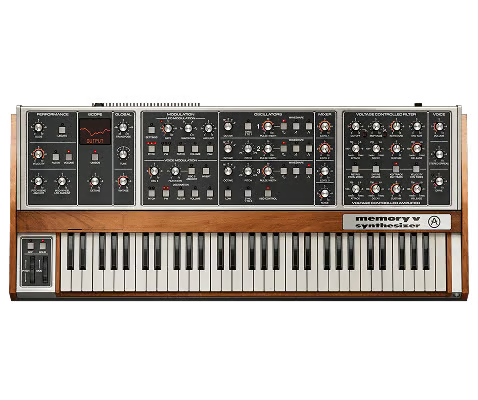
Arturia Memory V is a polyphonic synthesizer for Windows — a component-accurate recreation of the legendary 1982 Memorymoog, widely considered one of the most powerful and sonically dense polyphonic synthesizers ever made, capable of brass, pads, leads, and basses that no other synth of its era could match. Built on Arturia’s exclusive TAE® analog modeling technology, Memory V captures every aspect of the original hardware’s character — the weight, movement, instability, and edge of its triple-oscillator architecture, its 24 dB ladder filter, and its legendary analog non-linearities — then elevates it with modern tools no hardware unit ever had: drag-and-drop modulation, a four-layer Multi-Arp, a 4-slot FX rack with 17+ studio-grade effects, MPE support, and expanded Poly 12 voicing. The latest version is v1.0.0.8646 (May 20, 2026) — 284.79 MB installer for Windows 10+. A free demo is available through Arturia Software Center.
💡 Quick Summary
Arturia Memory V Windows v1.0.0.8646 (May 20, 2026) — TAE® component-accurate Memorymoog recreation. 3 free-running VCOs per voice (Ramp/Triangle/Square + PWM + OSC sync). 24 dB ladder filter per voice (switchable 12 dB) + Bass Compensation. Poly 6 + Poly 12 + Mono + Unison modes. Polyphonic LFO (5 waveforms). Voice Modulation (audio-rate per voice). Vintage + Dispersion controls. 4-layer Multi-Arp. 4-slot FX rack (17+ engines). Drag-and-drop modulation. MPE + aftertouch support. 4 macro controls. 300+ factory presets. Resizable GUI. 284.79 MB. Windows 10+. VST3 + AAX. Free demo via ASC.
By the Numbers
Signal Architecture
01 · Oscillators
Triple VCO Architecture
3 Free-Running VCOs per Voice
Three free-running oscillators per voice with stackable Ramp, Triangle, and Square waveforms, independent octave and pitch control, and pulse width modulation. Engage Sync 2-to-1 or Sync 1-to-3 for harmonically rich overtones. Unlock OSC 3 as an audio-rate modulator with Kbd Control off on Windows.
02 · Filter
Legendary Ladder Filter
24 dB LP + optional 12 dB + Bass Compensation
The iconic 24 dB low-pass ladder filter modelled per voice in component-accurate detail. Switch to 12 dB slope, push into self-oscillation for liquid squelching menace, or engage Bass Compensation to preserve low-end weight at extreme resonance settings on Windows.
03 · Voicing
Poly 6 · Poly 12 · Mono · Unison
Original 6-voice + Expanded Poly 12
Move between the original six-voice architecture and expanded Poly 12 mode for double the polyphony. Engage Unison, add detune, and spread across the stereo field for an 18-oscillator wall of analog sound from a single key press on Windows.
04 · LFO
Polyphonic LFO
Triangle · Saw · Ramp · Square · S&H
A polyphonic LFO with five waveforms. Sync to host tempo or run freely. Retrigger per voice. Route movement to oscillator pitch, pulse width, filter cutoff, volume, or pan for rich, animated modulation on Windows.
05 · Voice Mod
Audio-Rate Voice Modulation
OSC 3 or Filter Envelope → per voice
Route OSC 3 or the Filter Envelope to pitch, pulse width, filter, volume, or pan independently per voice. Chain the envelope into OSC 3 amount for shifting FM-style movement, or invert direction for descending sweeps on Windows.
06 · Analog Feel
Vintage + Dispersion
Continuous Component Drift
Recreate the idiosyncrasy of an original Memorymoog with Vintage and Dispersion controls. Introduce continuous analog drift and fine-tune variation across pitch, pulse width, levels, cutoff, emphasis, modulation, and envelope times on Windows.
07 · Mixer
4-Source Mixer
VCO1 · VCO2 · VCO3 · Noise
Independent levels for each of the three oscillators and the Noise generator. Dial in subtle blends or dense stacked tones. Combine all four sources for the fullest signal Memory V can produce on Windows.
08 · Output
Voice Output + Drive
Volume · Pan · Saturation Drive
Volume, Pan, and Drive form the final stage before the FX rack. Position each voice in the stereo field, then add saturation into both the filter and amplifier for harmonic richness, edge, and analog color on Windows.
Advanced Panel Features
🎼
4-Layer Multi-Arp
Stack up to four independent arpeggiator layers for intricate, evolving patterns. Create counterpoints, polymetric movement, and transposed melodies for hypnotic textures on Windows.
🎛️
Drag-and-Drop Modulation
Three modulator slots with envelopes, function generators, random LFOs, voice modulators, and Mod Sequencer sources. Drag any source onto any destination and fine-tune in seconds on Windows.
🎹
MPE + Expressive Keyboard
Assign velocity, release velocity, keyboard tracking, aftertouch, MPE slide, and mod wheel to any parameter for expressive performances beyond original hardware on Windows.
🎚️
4 Macro Controls
Four assignable macro controls map multiple parameters to a single knob — reshape your sound live from subtle variation to full tonal transformation during performance on Windows.
📊
Real-Time Oscilloscope
Displays post-FX output by default, then switches to show LFO or Voice Modulation signals when interacting with those parameters — turns abstract modulation visual on Windows.
🔄
Resizable GUI
Scale the interface for full visual immersion or to save screen real estate. Optimized for all screen sizes and display configurations on Windows.
📚
In-App Tutorials
Integrated in-app tutorials guide you through every aspect of Memory V, from individual parameters to tips from Arturia’s sound designers, without leaving the plugin on Windows.
🎯
KeyLab Integration
Seamlessly mapped for the Arturia KeyLab controller range with instant sound tweaking macros and easy DAW integration. Also works with any standard MIDI controller on Windows.
17+ Built-In FX Engines
〰️ Super Unison
🔷 Multi-Band Compressor
〰️ Chorus JUN-6
⏱️ Tape Delay
🌊 Reverb
🔥 Saturation
📼 Phaser
🎚️ EQ
🌀 Flanger
⚡ Transient Shaper
🎵 Pitch Shifter
↔️ Stereo Imager
What Artists Are Saying
“The Memory V recreates this beast of a machine, which has mythical status among musicians. Alongside the usual attention to detail, I really appreciate the additional voices, modulations and effects, making this a powerhouse virtual synth, worthy of its name!”
Paul Haslinger
Composer — film & TV
“The Memorymoog is one of the most powerful sounding synthesizers ever made. Arturia have captured that main character energy beautifully!”
Hannes Bieger
Producer / Sound Engineer
“Feeling very inspired from the beauty, warmth and flexibility the Memory V has to offer. Jumping from ethereal pads to deep sonic experiments and back to bendy dramatic strings in seconds. The ease of use, sound quality and smooth interface makes this a joy to work with.”
Headless Horseman
Producer / DJ
What the Press Says
“Arturia Memory V convincingly translates the legendary Memorymoog into the present day: monumentally broad, dense, and musical, with epic brass sounds, fat pads, powerful leads, modern modulation, strong effects, and precisely that meandering wall of sound that makes this synth myth so special even today. Without the headaches of the real hardware.”
Bonedo
Audio Equipment Review Publication
“If you love analog sound, the recent and constantly evolving synthwave, vaporwave and lo-fi waves, Memory V will have a place in your DAW… Moog sound from a golden age with Arturia’s quality seal in its emulation.”
Future Music ES
Music Technology Magazine
Version History
🆕 v1.0.0.8646 — May 20, 2026 (Latest / Initial Release) · 284.79 MB
+ Initial release — TAE® component-accurate Memorymoog recreation
+ 3 free-running VCOs per voice — Ramp, Triangle, Square + PWM + OSC sync
+ 24 dB ladder filter per voice — switchable 12 dB + Bass Compensation + self-oscillation
+ Poly 6 + Poly 12 + Mono Retrig + Mono Legato + Unison with detune and stereo spread
+ Polyphonic LFO — 5 waveforms, host sync, per-voice retrigger
+ Audio-rate Voice Modulation — OSC 3 or Filter Envelope to 5 destinations per voice
+ Vintage + Dispersion analog drift controls
+ 4-layer Multi-Arp with polymetric movement
+ 4-slot FX rack with 17+ studio-grade effect engines
+ Drag-and-drop modulation — 3 slots, envelopes/LFOs/Mod Sequencer
+ MPE + aftertouch + mod wheel + velocity routing
+ 4 assignable macro controls
+ Real-time oscilloscope scope display
+ 300+ factory presets across vintage brass, basses, keys, pads, leads, SFX
+ In-app tutorials + resizable GUI + Arturia Software Center (ASC) licensing
Plugin Formats — Windows
🎵 VST3 (64-bit)
🎵 AAX — Pro Tools (64-bit)
🍎 AU — macOS only
System Requirements — Windows
| Requirement |
Details |
| Operating System |
Windows 10 or later (64-bit) |
| Plugin Formats |
VST3, AAX (64-bit) |
| Version |
v1.0.0.8646 — May 20, 2026 (latest) |
| Installer Size |
284.79 MB |
| License |
Arturia Software Center (ASC) — up to 5 computers simultaneously |
| Demo |
Free demo available via Arturia Software Center |
| Voicing |
Poly 6, Poly 12, Mono Retrig, Mono Legato, Unison |
| Presets |
300+ factory presets across 6+ sound categories |
| FX |
4-slot rack with 17+ engines including Super Unison, Chorus JUN-6, Tape Delay |
| Also macOS |
macOS 11.0+ — AU, VST3, AAX — 425.95 MB |
| Developer |
Arturia (arturia.com) |
Pros & Cons
✅ Pros
- ✓TAE® component-accurate Memorymoog — verified by hardware owners
- ✓3 VCOs per voice — Sync, PWM, audio-rate OSC 3 modulation
- ✓24 dB ladder filter — self-oscillation + Bass Compensation
- ✓Poly 12 — double the original six-voice polyphony
- ✓18-oscillator Unison wall of sound
- ✓4-layer Multi-Arp with polymetric movement
- ✓17+ FX engines including Super Unison + Chorus JUN-6
- ✓MPE + aftertouch + drag-and-drop modulation
- ✓300+ factory presets — immediately usable
- ✓License on up to 5 computers simultaneously
- ✓Free demo available via ASC
- ✓Resizable GUI + in-app tutorials
⚠️ Cons
- ✗No VST2 support — VST3 and AAX only
- ✗Requires Arturia Software Center for activation
- ✗284 MB installer — heavier than some competitors
- ✗Poly 12 mode is more CPU intensive than Poly 6
Frequently Asked Questions
What is Arturia Memory V for Windows? ▾
Arturia Memory V is a polyphonic synthesizer plugin for Windows — a component-accurate TAE® recreation of the legendary 1982 Memorymoog. Version v1.0.0.8646 was released May 20, 2026. It features 3 free-running VCOs per voice (Ramp, Triangle, Square with PWM and oscillator sync), a 24 dB ladder filter per voice (switchable to 12 dB, with Bass Compensation and self-oscillation), polyphonic LFO with 5 waveforms, audio-rate Voice Modulation, Vintage and Dispersion analog drift controls, Poly 6 and Poly 12 voicing, Mono Retrig, Mono Legato, and Unison modes with up to 18 oscillators stacked. Advanced panel includes a 4-layer Multi-Arp, 4-slot FX rack with 17+ engines, drag-and-drop modulation with 3 slots, MPE and aftertouch support, 4 macro controls, and real-time oscilloscope. 300+ factory presets. 284.79 MB. Windows 10+. VST3 and AAX. Licensed via Arturia Software Center on up to 5 computers simultaneously. Free demo available.
What is the Memorymoog and why is it legendary? ▾
The Memorymoog was released by Moog Music in 1982 as the company’s most ambitious polyphonic synthesizer — and its final polyphonic design before Moog Music declared bankruptcy in 1987. It was conceived as a polyphonic answer to the Minimoog, bringing the same rich ladder filter tone but opening it up for six-voice chords, layered brass and wide harmonic movement. Three oscillators per voice gave it a harmonic depth that competing polysynths simply could not match. Artists including Geddy Lee of Rush, Tony Banks of Genesis, Stevie Wonder, and Tangerine Dream all used its distinctive dense tone on landmark recordings. Original restored units now trade for $15,000 or more, making Memory V on Windows the only practical way to access that iconic sound today.
What is TAE® and how does it work in Memory V? ▾
TAE® (True Analog Emulation) is Arturia’s proprietary analog modeling technology that accurately mimics the behavior of analog circuits at the component level rather than simply sampling or approximating them. In Memory V, TAE® models the Memorymoog’s oscillators, ladder filter, mixer, drive circuit, and all analog non-linearities — including the instability, drift, saturation, and the self-oscillation characteristics of the original hardware. This includes the subtle variation between voices, the interaction of the filter at high resonance, and the harmonic behavior of the oscillator waveforms. The result is a plugin that behaves dynamically like the original hardware rather than sounding like a static snapshot of it — verified as authentic by professional studio owners who own original Memorymoog units.
How does the 4-layer Multi-Arp work in Memory V? ▾
The Multi-Arp in Memory V allows you to stack up to four independent arpeggiator layers simultaneously, each with its own pattern, rate, octave range, and note order. Because the four layers are independent, they can run at different rates and step counts — a 3-step layer over a 4-step layer creates polymetric drift that takes 12 steps to return to the start. You can create counterpoint melodies, rhythmically offset textures, and transposed parallel lines all playing at once from a single chord held on the keyboard. This goes far beyond what any hardware arpeggiator could achieve and is one of the most powerful creative tools in Memory V on Windows.
Download Arturia Memory V Windows full version — v1.0.0.8646, TAE® Memorymoog recreation, 3 VCO, 24dB ladder filter, Poly 12, 4-layer Multi-Arp, 17+ FX, 300+ presets!
🙏 I just ask for thank you, that's all.